
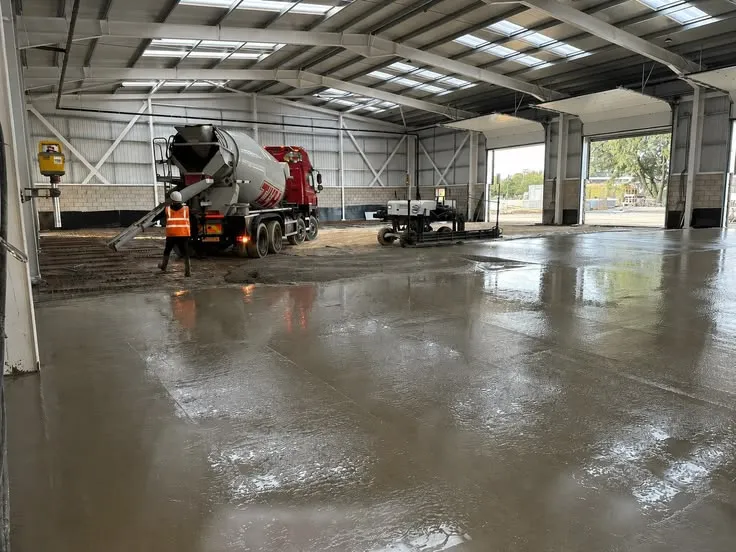
Concrete dusting can seem like a minor housekeeping issue, but in an active warehouse it often signals that the slab surface is wearing down. Fine particles may collect on racks, packaging, equipment, and inventory while forklifts and pallet jacks continue grinding the surface. Over time, dust can increase cleaning demands and make worn traffic lanes more visible. Facility managers who understand why concrete begins dusting can decide whether maintenance, localized repair, or a broader flooring upgrade is the best response.
Dust Starts With Surface Breakdown
Concrete develops a hard, wearing surface when it is properly placed, finished, cured, and maintained. As that upper layer deteriorates, fine particles can loosen under traffic.
Age, abrasion, weak surface material, repeated impact, and previous construction conditions may all contribute. In some warehouses, the problem is concentrated in forklift aisles or turning areas. In others, dust appears across large sections.
The pattern matters because widespread deterioration may require a different response from one isolated damaged zone.
Traffic Accelerates Wear
Forklifts, pallet jacks, carts, and other wheeled equipment continually move across warehouse floors. Their tyres can abrade weak concrete and spread loose particles beyond the original wear area.
Turning points often experience more stress because wheels create additional lateral force as vehicles change direction. Dock approaches, rack ends, intersections, and staging areas can therefore become dusting hotspots.
Warehouse Flooring Contractors should review these traffic patterns before recommending a resurfacing system. Knowing where the greatest mechanical stress occurs helps determine how the slab should be prepared and where repairs need extra attention.
Dust Affects More Than Cleaning
Fine concrete particles do not necessarily remain on the floor. Vehicle movement and air circulation can distribute them to nearby shelving, stored goods, machinery, and work surfaces.
This can increase housekeeping requirements, particularly where packaging or products need to remain clean. Dust may also make floor markings harder to maintain and can combine with oils or moisture to create more difficult cleaning conditions.
A sealed resinous surface can reduce exposure to a worn porous concrete face, but only after the underlying slab is properly evaluated and prepared.
Preparation Matters More Than Covering
Applying a coating directly over dusty or weak concrete is not a reliable solution. If the surface beneath the resin remains unsound, adhesion can be compromised.
Mechanical preparation such as diamond grinding or shot blasting can remove weak material, previous coatings, and contamination while creating a suitable profile for the new flooring system. Cracks, spalls, and damaged joints should also be repaired where necessary.
Facilities considering Epoxy Flooring New Jersey Nj should pay close attention to these preparation steps. They may disappear beneath the finished surface, but they strongly influence how the new system performs.
Moisture Can Complicate Failure
Not every flooring problem is caused only by traffic. Moisture moving through concrete can contribute to coating issues and should be investigated when there are warning signs such as bubbling, unexplained delamination, or recurring damp areas.
A professional assessment can help determine whether moisture testing or mitigation should be included. This is especially important when an older coating failed for reasons that were never clearly identified.
Covering a moisture-related problem without addressing its cause can simply start another repair cycle.
Stable Floors Support Markings
Warehouses often use floor markings to separate forklift lanes, pedestrian paths, staging areas, restricted zones, and storage locations. These markings perform better when the underlying floor is stable and clean.
Dusting concrete can make painted lines look dirty or worn quickly. A properly prepared resinous floor can create a more consistent base for traffic markings while simplifying routine cleaning.
Managers should plan lane colors and safety markings before installation so they can be integrated logically into the finished system.
Maintenance Still Matters
A new floor does not eliminate the need for maintenance. Abrasive debris should be removed regularly because grit carried under vehicle tyres can contribute to wear.
High-traffic lanes, joints, loading docks, and turning areas should also be inspected periodically for chips or localized damage. Small problems are generally easier to address before heavy traffic makes them larger.
Keeping simple maintenance records can also help facility teams identify recurring wear patterns.
Conclusion
Concrete dusting is more than an appearance problem in an active warehouse. It can increase cleaning demands, spread particles throughout the facility, reveal slab deterioration, and signal that high-traffic areas need closer attention.
A lasting response begins with understanding why the surface is breaking down. Traffic analysis, mechanical preparation, concrete repair, moisture evaluation, appropriate flooring selection, and routine maintenance all contribute to a better result. By treating dusting as an early warning sign rather than just another cleaning task, warehouse managers can address deterioration before it becomes a larger operational problem.
